


At the beginning of each year, a number of works whose copyright has expired enter the public domain .
Below, is a non-exhaustive list of works that will be in the public domain in 2025:
.
However, what is the public domain itself ?
In short, the public domain is a shared cultural heritage that anyone can use, without the need for licensing agreements1. This heritage consists of works for which copyright has expired .
The public domain includes all types of works, such as photographic, musical or audiovisual works .
The public domain is designated as follows²:

How long does the protection for author’s economic rights last?
Protection for economic copyrights is temporary and lasts for 70 years (or 50 years – depending on the applicable law, e.g. convention or Polish law):
| Berne Convention for the Protection of Literary and Artistic Works of 9 September 1886, reviewed in Berlin on 13 November 1908 and in Rome on 2 June 1928 (ratified pursuant to the Act of 5 March 1934). (“Convention” ) | Act of 4 February 1994 on Copyright and Related Rights (Journal of Laws 2022, item 2509, i.e.) (“PrAut”) . |
| Art. 7 | Article 36 |
| (1) The duration of the protection conferred by this Convention shall cover the life of the author and fifty years after his death.
(2) If, however, the term of protection is not uniformly accepted by all the Länder, it shall be determined by the legislation of the state in which protection is sought, and shall not exceed the term of protection granted in the state in which the work was created. Accordingly, the Länder shall apply the preceding paragraph only insofar as it is consistent with their internal law. (3) For photographic works and works obtained in a similar manner to photography, for posthumous works, for anonymous works or works published under a pseudonym, the duration of protection shall be determined by the law of the country in which protection is sought; however, this duration may not exceed that of the country in which the work was created.
|
Subject to the exceptions provided for by law, author’s economic rights shall expire seventy years:
1) from the death of the author and, with respect to co-authored works, from the death of the co-author who survives the others; 2) with respect to a work whose author is unknown, from the date of first distribution, unless the pseudonym leaves no doubt as to the identity of the author or if the author has disclosed his identity; 3) with respect to a work for which the author’s economic rights are vested by law in a person other than the author, from the date of distribution of the work and, where the work has not been distributed, from the date of its determination; 4) with regard to an audiovisual work – from the death of the last deceased of the following persons: the main director, the author of the screenplay, the author of the dialogues, the composer of the music composed for the audiovisual work; 5) with respect to a verbal and musical work, if the verbal work and the musical work were created specifically for the verbal and musical work, from the death of the later of the following persons: the author of the verbal work or the composer of the musical work. |
However, the Polish legislator was not the only one to modify the term of protection under the Convention. In fact, virtually identical protection has been adopted by other European countries.
Below are examples of the legal regimes and the resulting duration of protection for author’s economic rights.
US:
US regulations, as a general rule, provide for copyright protection up to 70 years after the death of the creator. They modify this rule, whereas, for works authored by corporations, a period of 95 years after its publication or 120 years after its creation applies – whichever is shorter3.
China:
China, on the other hand, provides, as a general rule, a period of 50 years counted from the death of the creator.
India:
In India, protection will last 60 years from the death of the creator. However, for works published posthumously, the 60-year period will be calculated from their publication .
Spain:
As a general rule, Spanish law provides for 70-year protection of copyright from the death of the author. However, it modifies this rule with respect to works by authors who died before 7 December 1987, for which protection expires 70 years after their first publication.
Therefore, it is important to check each time for specific jurisdictions whether the copyright protection has already expired .
How should these periods ofprotectionbe calculated?
The 70-year period is calculated from 1 January of the year following the death of the creator.
In contrast, the regulation closest to us, i.e. the Polish one, can be defined by the following divisions:
As a general rule, author’s economic rights expire seventy years:
- from the death of the author;
- and for co-authored works, from the death of the co-author surviving the others.
With regard to a work whose author is unknown, the author’s economic rights shall expire seventy years
- from the date of first distribution, unless the pseudonym leaves no doubt as to the identity of the author or if the author has disclosed his identity.
With regard to a work for which the author’s economic rights are vested by law in a person other than the author, the author ‘s economic rights shall expire seventy years
- from the date of distribution of the work ,
- and, where the work has not been distributed, from the date of its determination.
With regard to an audiovisual work, copyrights shall expire seventy years
- from the death of the latest deceased of the following persons: the principal director, the author of the screenplay, the author of the dialogues, the composer of the music composed for the audiovisual work.
With regard to a verbal-musical work, if the verbal work and the musical work were created specifically for the verbal-musical work, the economic copyright shall expire seventy years
- from the death of the later of the deceased: the author of the verbal work or the composer of the musical work.
Can works in the public domain be used freely?
In principle, yes .
Infringement of another’s rights may not exist – but only, in principle, because moral rights do not expire.
This means that the attribution of authorship to a work created by someone else may give rise to a claim for an indefinite and non-waivable or transferable link to the work, and thus may even give rise to an award of compensation for non-material damage suffered.
How to use a public domain safely ?
Although the use of the public domain appears to be unencumbered by any additional conditions this is not always so obvious.
When using works in the public domain, at least the following should be borne in mind :
- the term of protection of author’s economic rights may vary depending on a given legal order, which means that, e.g. use of a work in Poland may be legal, while in the United States, use of the same work may not ;
- moral rights may not expire in a given legal order (e.g. Poland), while in another their legal protection may last for a longer period of time than that provided for economic copyrights (e.g. United Kingdom with respect to false attribution of authorship), which results in the necessity to identify the real author of a given work ;
- other existing intellectual property right protecting the work or a part of it – it is not uncommon for a work currently in the public domain to be registered as a trade mark protected under selected classes of goods and services, which may update the trade mark owner’s claim against the user of the work;
- moral rights – finally, any use of the work may infringe the moral rights of the heirs of the creator of the work in question, such as his artistic creation.
But what does the use of goods in the public domain mean in practice ?
It should be borne in mind that one can make use of exactly the form of the good that entered the public domain and not of later versions created after that time .
In this context, we can refer to the case of finding itself in the public domain in 2024. “Steamboat Willie.”
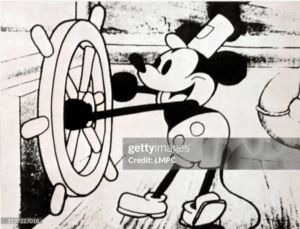
/LMPC via Getty Images/ .
The fact that the Steamboat Willie version of Mickey Mouse found its way into the public domain did not mean that all versions of Mickey Mouse and its later concepts ceased to be protected by copyright .
On the contrary, the modern versions of Mickey Mouse still benefit from the protection provided by the relevant legislation, i.e. either copyright or industrial property law. Therefore, using them without the authorisation of the entity entitled to them may result in civil liability – including that resulting from the infringement of not only moral rights, but also property rights .
About author

 Ask author
r. pr. dr Marek Porzeżyński
 Ask author
apl. adw. Mariola Połeć
Media contact

 Polish