

BENEFICIARIES OF THE FAMILY FOUNDATION AND REGISTRATION OF ACTUAL BENEFICIARIES WITH THE CRBR
9 July 2025 • Autor: Kancelaria Brysiewicz Bokina i Wspólnicy
BENEFICIARIES OF A FAMILY FOUNDATION VS. DECLARATION OF REAL BENEFICIARIES TO CRBR
Since May last year, we have been able to set up a new type of legal entity – the family foundation. With the entry into force of the family foundation legislation, the provisions of the Anti-Money Laundering and Countering the Financing of Terrorism Act (“AML Act“) also changed. There are links between these provisions that generate obligations on the part of the family foundation to report the family foundation’s beneficial owners to the Central Register of Beneficial Beneficiaries (“CRBR“), which are discussed below.
At the outset, we point out that the concept of beneficiary under the family foundation legislation does not coincide with the concept of beneficial owner under the AML Act, and therefore the circle of beneficial owners does not necessarily coincide with the circle of beneficiaries of the family foundation.
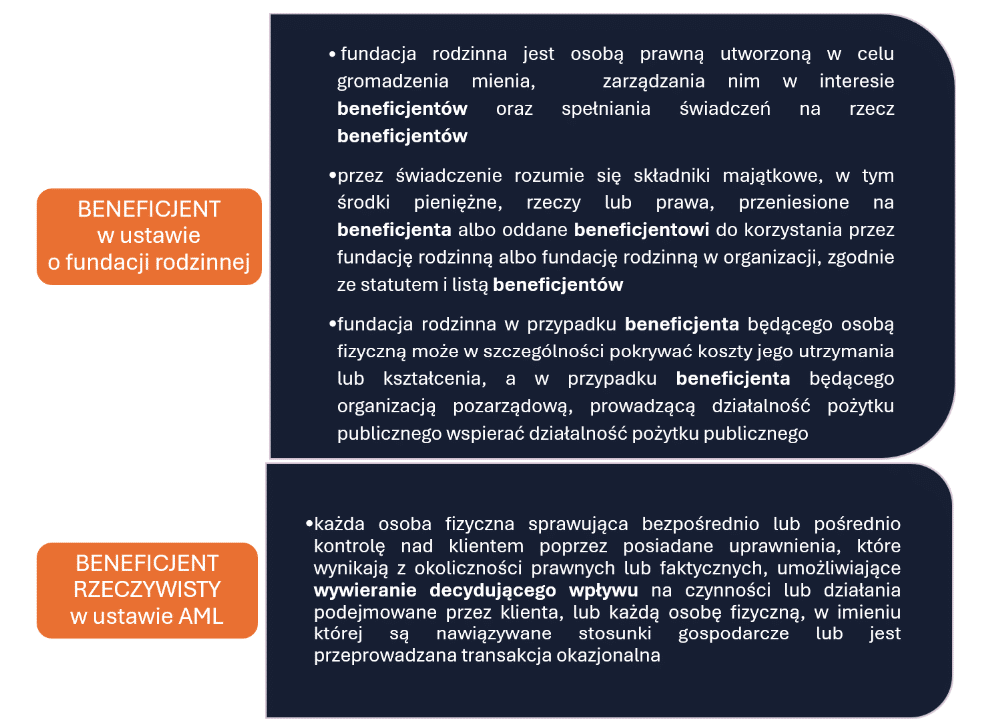
- Duty to notify to the CRBR
A family foundation is subject to the provisions of the AML Act and is consequently subject to the obligation to disclose its beneficial owners in the CRBR. The purpose of the register is to facilitate the identification of individuals who determine the activities of business entities and, therefore, individuals who exert decisive influence on the operation of a family foundation are subject to registration in the CRBR.
Although Article 58 of the AML Act does not explicitly identify a family foundation as a separate entity that is obliged to report information on beneficial owners, nevertheless, a family foundation is treated as a trust under the AML Act, and it is on this basis that it should fulfil the obligation to disclose data on beneficial owners.
Admittedly, under the AML Act, not all trusts are obliged to report information on beneficiaries, as this only applies to trusts whose trustees or persons holding equivalent positions:
- have their domicile or seat in the territory of the Republic of Poland or
- establish business relations or acquire real estate in the territory of the Republic of Poland in the name or on behalf of a trust
Therefore, it can be concluded that not all family foundations will be subject to such disclosure, nevertheless, bearing in mind the nature of a family foundation, it should be assumed that the vast majority of them will meet the criteria indicated above.
However, for the avoidance of any doubt, it should be recommended that the legislator explicitly designates a family foundation in Article 58 of the AML Act.
Thus, in the case of a family foundation, persons exercising control over the family foundation, i.e. persons who can exert a decisive influence on the activities or actions undertaken by the family foundation, should be reported as the real beneficiary and will not always and as a rule be the beneficiaries of the family foundation.
The catalogue of persons who may be treated as tangible beneficiaries is very broad. Indeed, the AML Act indicates that a beneficial owner may be a founder, a board member, a supervisory board member, a beneficiary and, where the natural persons benefiting have not yet been identified, a group of persons in whose main interest the family foundation was established or operates, as well as other persons who actually exercise control over the family foundation.
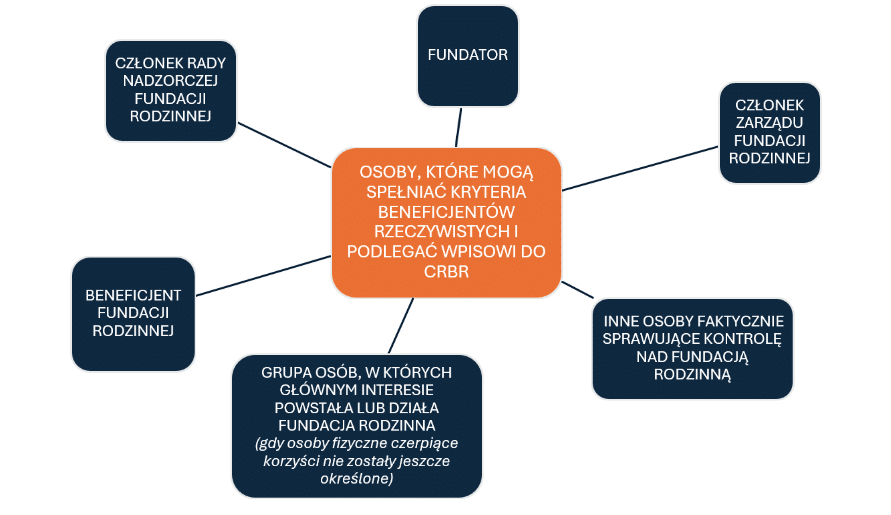
- The problem of disclosure in the CRBR
While the assumptions of the Family Foundation Regulations provide for the confidentiality of the list of beneficiaries of the family foundation, the provisions of the AML Act allow for public access to the register.
Indeed, the CRBR is a universal, public and free register, accessible to anyone from an internet search engine. In this way, despite the data protection under the Family Foundation Act, it is easy to find out the names, surnames, PESEL number of the beneficiaries of the actual family foundation. Undoubtedly, such a regulation constitutes a significant interference with the fundamental rights to respect for private life and protection of personal data. This issue has already been decided by the Court of Justice of the European Union in its judgment of 22 November 2022 (C-37/20, C-601/20), however, the ruling has not yet been reflected in the AML legislation.
| Author | |
 |
advocate Katarzyna Gelo |
| legal assistant Emilia Skibowska |

 Zadaj pytanie autorowi